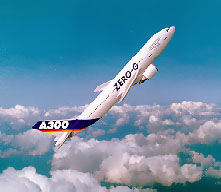
The 29th ESA parabolic flight campaign
(Mérignac, Bordeaux - France 10th 21th March 2002)
|
|
- Detection of space motion sickness early stages in microgravity thanks to skin electrodes
- Recording of the gastric and duodenal electrophysiological activity and of the salivary cortisol level
- Assessment of a training system by electrophysiological bio-control in order to optimise the adaptability to stress
|
- Objectives of the experiment
- Description of the experiment
- Description of the used equipment
- Installation of the experiment
1. Objectives of the experiment :
It is proposed to test the use of :
- the electrogastric and duodenal activity
- the skin conductance
- the salivary cortisol
Theses physiological responses could be considered as space motion sickness indications during the parabolic flight. Besides, several studies (Ames research center) enable the scientists to develop methods of controlling by biofeedback : 85 % of the trained subjects generate a drop in the reactions to the stimuli bringing about space motion sickness.
During the flights, a training method by electrophysiological biofeedback will be tested.
Consequently, the results of the proposed study may be useful from two perspectives :
the autogenic feedback training involves learning self-suggestion exercices to regulate physiological responses to stimuli. Other works have shown that it is possible to control gastric and digestive motricity. Different studies on the ground have been carried out by Martin on biofeedback, which is the visualization of electrophysiological signals, and the learning, using these signals, of the regulation of physiological processes under the control of the central nervous system. This technique will be studied in order to allow astronauts to avoid nausea and vomiting, by means of specialised equipment adapted to nausea resistance training, involving a computer.
The originality of the project is the use of expert systems applied to electrosplanchography, which make it possible to test the different relations that can be extracted from tests and can also help to model the effects of stress and SMS.
2. Description of the experiment :
The studied phenomena are :
- Gastric and duodenal activity :
The viscera electrophysiological signals transmitted to the intestines and the colon, and which are studied thanks to : electrosplanchnography (ESG), and more especially the stomach with electrogastrography techniques (EGG). The functional significance of the tachygastria will be particularly studied as a consequence of travel sickness. It is possible to train spacemen by electrophysiological biofeedback to prevent them from suffering from space motion sickness and stress thanks to psychovisceral relations.
Contractile digestive viscera generate electrophysical signals that are transmitted to the surface through the abdominal cavity. The stomach, intestine and colon, specifically studied with electrogastrography, have been analysed with electrosplanchnography techniques. The normal value of the electrogastrogram signal, the basic electrical rhythm of the recording activity of the gastric musculature, is approximately 3 cycles / min. Tachygastria, the abnormally high frequency EGG observed during motion sickness, attains 4-9 cycles / min ; the functional significance of tachygastria, particularly as a consequence of motion sickness, remains to be studied.
Thus, it is possible to study electrophysical signals in order to investigate the occurrence of tachygastria, precursor sign of motion sickness, and it is also possible to train astronauts by electrophysiological biofeedback to prevent space motion sickness and by the role of the psycho-visceral relationship to train the astronauts against stress.
- Skin conductance :
The modifications of skin electrical properties (cold sweat, etc...) make up a set of signification symptoms in space motion sickness. The skin conductance turns out to be an objective measurement. Cold sweating together with facial pallor are the most reliable secondary symptoms of motion sickness, the primary manifestations being nausea and vomiting. Skin conductance has been shown to be an objective measure of such sweating using mass spectrometry of water vapour drawn from the skin using dry nitrogen gas flow. It has been demonstrated that the phasic components of skin conductance are good indicators of motion sickness induced by either cross-coupled or translational motion simulators experimented in laboratory.
The skin of the forehead is the best recording location in terms of motion sickness, since skin conductance activity from other locations such as fingers or the palms of hands, indicates non-specific sympathetic autonomic responses to mental or emotional arousal such as excitement, anxiety, sensory stimuli or motor preparatory reflexes. The skin of the forehead does not respond to such non-specific stimuli but will respond by producing bursts of phasic skin conductance activity to the onset of motion sickness. There have been some conflicting observations as regards space sickness. For example Money concluded that cold sweating and facial pallor reliably followed space sickness after reviewing Russian reports on space sickness of cosmonauts, but Young suggested that cold sweating and facial pallor are absent in space motion sickness in the Space Shuttle, perhaps because of fluid shift or a low humidity environment.
Thus it is of practical and theoretical interest to verify whether or not cold sweating, as quantified by skin conductance, occurs with motion sickness in the ESA parabolic flight which is designed to simulate some aspects of the true microgravity space flight environment. If established as a useful indicator in-flight then it will be possible to incorporate as one indicator in any motion sickness desensitisation biofeedback training of potential ESA mission specialists.
- Salivary cortisol :
- A variety of stress hormones is released because of space motion sickness like ACTH, the cortisol and other hormones like the growth hormone, the thyroid hormone, the prolactin, the arginin, the beta endorphin and the noradrenalin. Among them, the vasopressin is the most linked with space motion sickness but the cortisol is easily measured.
- A recent study revealed the salivary cortisol sharply increases during 20 to 30 minutes following travel sickness. The results of this non-invasive method turn out to be solid with the blood cortisol samples which are obtained by using the invasive method.
- There are individual differences in the cortisol measurement and they are linked with space motion sickness susceptibility. Besides, the cortisol considered as a response to stress may also act in a protective way for space motion sickness. The result of the proposed study may be useful according to two points of view :
- The salivary cortisol is a non-invasive objective indicator of space motion sickness.
- The individual differences in the salivary cortisol levels constitute space motion sickness warning signs. Motion sickness produces a variety of autonomic consequences including salivation, gastric stasis & changed EGG. There were large individual differences in cortisol response and these individual differences were related to motion sickness susceptibility where higher motion resistance related to greater cortisol response. The latter finding is consistent with the findings of Kohl. In other types of sickness such as the nausea and vomiting induced by emetogenic cancer chemotherapy with cisplatin, adrenocorticotropic hormone (ACTH) treatment which induces cortisol release, has been shown to be effective in reducing nausea and vomiting. There is evidence that corticosteroids may reduce nausea and vomiting due to hyperemesis gravidarum in pregnancy and reduce postoperative nausea and vomiting. Lower baseline cortisol has been reported to predict those patients most likely to suffer nausea and vomiting with cisplatin treatment and higher cortisol to predict greater resistance against such nausea and vomiting. Thus the possibility exists that cortisol although seen as a stress response may be acting also in a protective manner in motion sickness and other types of sickness.
- Bio-feedback :
Towards the end of the 60th , a handful of researchers in several countries has given the proof that humains and animals can learn to control consciously their deepest inner processes. A tracing, a sound or a light produces the feedback, which is necessary to guide them. What this implicates is so surprising, so irresistible that the therapy of the biofeedback has become a reality, almost before experiments have been made. Institutions of biofeedback have already been opened in the east and west of the United States. In the whole world, hospitals and clinincs have developed an electrical equipment intended for an experimental apprenticeship.The list of illnesses dealt with successfully, evokes the litany of charlatan merchants of snake oil: cardiac arythmy, angina, migraine and cephaleen of hypotension, intestinal problems, powerlessness and even epilepsy. The problem is brought up by a sharp comment of Neal Miller, Rockfeller University, pioneer of the feedback.
It is the matter of knowing if humans can learn to control themselves as well as the rats are able to. “ I think”, says Miller, “that in this point, humans are as intelligent as rats but a recent critical report shows that things remain still to be proved.
During more than two centuries, the British colonizers have taken notice of the exploits of the yogis indians, who seem to have possessed a capacity of auto-domination, coming from miracle. Harry Houchni (?), the americain magicien, had so much control on his internal organs that he was capable of regurgitating a key which allowed him to free himself of padlocked chaines which kept him under water. A lot of comedians have learnt to cry at will. Miller reminds that there have never been solid basis to affirm that one is not capable of giving consciously order for vegetative proccesses.
The first experiments haven’t been very conclusive: Well, Pavlov’s dogs have proved, by salivating, the existance of a kind of capacity in the internal organs, to learn but that has been considered as a “classical conditionning”. And under this rubric, this passed for a simple variety of apprenticeship. During more than ten years, Miller hasn’t succeeded in getting his students’, not even his paid assistants’, interest for his theory. “Almost always, I ended up by letting them work on something which seemed less absurd for them”, comments Miller. His first results, “encouraging but not decisive”, were presented at the 18th International Congress of Psychology in Moscow, in 1966.
In 1967, Miller and Alfredo Carmona gave responses to a group of dogs when they salivated, and to an other group when they reduced their salivation.
A member of the team, Jay Crowill, had begun to make experiments with a rat which had been paralyzed by the curare, this deadly south american poison. The rats were kept alive with artificial respiration, since the curare paralyzes the respiratory activity and were rewarded when they accelerated or slowed down the batting of their heart. The curare guaranteed the impossibility for the rats to “cheat” by using their muscles of the cardiac region: the rationalist researchers have indeed supported for a long time that the yogis who stopped their heart, succeeded their exploit by making an extreme muscular effort. The “reward” of the rats was a stimulation of the center of pleasure of their brain. Evenually, to prove that a stimulation of the brain was not the only efficient reward, the researchers have trained a group of rats to control their cardiac rhythm by rewarding them with the absence of a punishment with electrical shock.
During the two following years, Miller and Leo Dicara, have worked out a range of instructions by feedback, at Yale. Having learnt from the Russians that a dog can detect the exact place of a small ball filled with water placed in the rectum, they placed balls of the same type in the rectum of rats. They measured and rewarded the domination of the intestinal contractions.
In other experiments, the rewarded rats, when they controlled their formation of the urin, seeming to have learnt to modify the rate of the blood flux in the kidneys, which modified the rate of filtering. Other rats have learnt to control the blood quantity in their lining of the stomach.
3. Description of the used equipment :
- 7 électrodes
- 3 Medical holter ELA MEDICAL (model 2448 class 2 : EGG/ECG, Skin conductance and flight acceleration recording)
- A fastened belt
- A static memory recorder
- A set of 6 electrodes
4. Installation of the experiment :
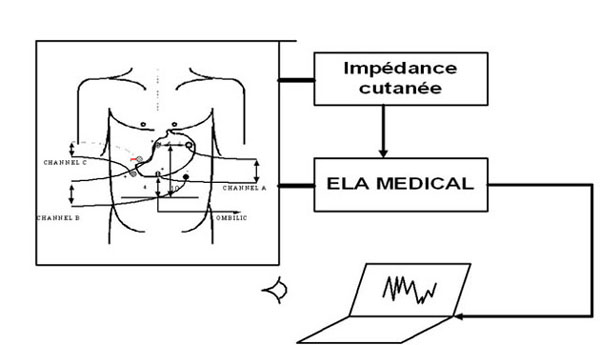
9 different subject physiological responses will be recorded during 3 days (30 paraboles per flight) and the different clinical signs will be also recorded thanks to a vocal recorder and a portable computer. The equipment is :
- A portable recorder (model 2448, class 2 ELA MEDICAL) equipped with static memory allowing the recording of 3 electro physiological derivations of vertical acceleration and skin conductance.
- A skin conductance recorder interfaced to the ELA MEDICAL recorder
- A set of 6 electrodes able to record the stomach movements in microgravity
- A flat-top computer recording the clinical signs and the electrophysiological biofeedback of one of the 3 subjects.
- Optional equipment disposes : the Torrelec equipment of visual biofeedback of the Science University of Tours.
- Saliva sampling allowing the recording of the salivary cortisol at different moments of the flight.
3 people for each flight. Each subject has :
- A holter recording his or her electrophysiological signals (ECG/EGG) a certain number of psycho/physiological parameters :
- A skin conductance recorder
- A subject a flat-top computer and tests a method of biofeedback. During the flight, a certain number of movements will be effectuated by the subjects : head and trunk movements over the period preliminary to the microgravity period, 30 seconds (1.8 G hypergravity before and after Zero-G stages) etc... All these movements must be carefully noted.
Protocol on board the plane :

- SUJET 1 : Holter ELA MEDICAL SYNESIS + boîtier SC skin conductance + acceleration measure
- SUJET 2 : Holter ELA MEDICAL SYNESIS + boîtier SC skin conductance + video / photo
- SUJET 3 : Holter ELA MEDICAL SINE FLASH + PC portable