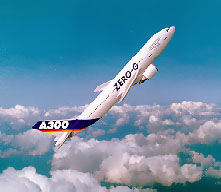
The 29th ESA parabolic flight campaign
(Mérignac, Bordeaux - France 10th to 21th March 2002)
Space Motion Sickness (SMS) is a form of motion sickness which affects approximately 70 % of novice astronauts and cosmonauts to some degree in the first 24-48 hours of a mission. It results in loss of performance and can pose potential hazards if it occurs to the extent of vomiting in a space suit outside of a spacecraft.
It is proposed to test the usefulness of:
gastric and duodenal electric activity
skin conductance (a measure of cold sweating)
as indicators of motion sickness during ESA parabolic flight, and
salivary cortisol
as a correlate of motion sickness and a possible predictor of motion sickness susceptibility.
It is envisaged to test electrophysiological biofeedback by training system.
Previous works developped at the Ames Research Center have developed biofeedback and autogenic control which is successful in 85 % of those trained, reducing reactions to provocative motion sickness stimuli. The autogenic feedback training involves learning self suggestion exercises to regulate physiological responses to stimuli.
From this study it is hoped that a greater understanding of the relationship between space motion sickness, gastric and duodenal activity, skin conductance and salivary cortisol levels will enable the development and improvement of training methods for ESA astronauts in order to help them to overcome space motion sickness. As a correlate of motion sickness and a possible predictor of motion sickness susceptibility.
The originality of the project is the use of expert systems applied to electrosplanchography, which make it possible to test the different relations that can be extracted from tests and can also help to model the effects of stress and SMS .