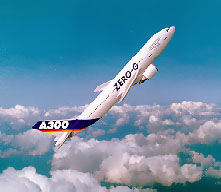
The 29th ESA parabolic flight campaign
(Mérignac, Bordeaux - France 10th to 21th March 2002)
|
|
Gastric and duodenal activity
Contractile digestive viscera generate electrophysical signals that are transmitted to the surface through the abdominal cavity.
The stomach, intestine and colon, specifically studied with electrogastrography (EGG), have been analysed with electrosplanchnography techniques (ESG)(Thouvenot, 1998).
The normal value of the electrogastrogram signal, the basic electrical rhythm of the recording activity of the gastric musculature, is approximately 3 cycles / min.
Tachygastria, the abnormally high frequency EGG observed during motion sickness, attains 4-9 cycles / min ; the functional significance of tachygastria, particularly as a consequence of motion sickness, remains to be studied.
Thus it is possible to study electrophysical signals in order to investigate the occurrence of tachygastria, precursor sign of motion sickness, and it is also possible to train astronauts by electrophysiological biofeedback to prevent space motion sickness and by the role of the psycho-visceral relationship to train the astronauts against stress.
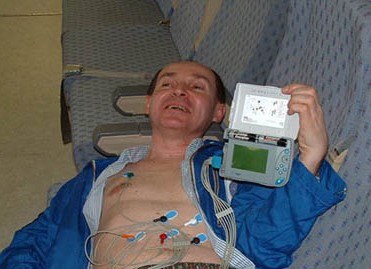
ELA MEDICAL Holter graphical programming
|
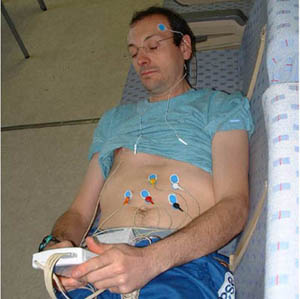
Skin conductance and electrogastrogram electrodes set-up
|
Skin conductance
Cold sweating together with facial pallor are the most reliable secondary symptoms of motion sickness, the primary manifestations being nausea and vomiting (Benson and al.,1988).
Skin conductance has been shown to be an objective measure of such sweating using mass spectrometry of water vapour drawn from the skin using dry nitrogen gas flow.
It was demonstrated (Golding and al., 1992) that the phasic components of skin conductance are good indicators of motion sickness induced by either cross-coupled or translational motion simulators in the laboratory (Golding and al., 1992).
The skin of the forehead is the best recording location in terms of motion sickness, since skin conductance activity from other locations such as fingers or the palms of hands, indicates non-specific sympathetic autonomic responses to mental or emotional arousal such as excitement, anxiety, sensory stimuli or motor preparatory reflexes.
The skin of the forehead does not respond to such non-specific stimuli but will respond by producing bursts of phasic skin conductance activity to the onset of motion sickness (Golding and al., 1992).
There have been some conflicting observations as regards space sickness. For example Money (Money and al., 1991) concluded that cold sweating and facial pallor reliably followed space sickness after reviewing Russian reports of space sickness in cosmonauts, but Young (Young, 2000) suggested that cold sweating and facial pallor are absent in space motion sickness in the Space Shuttle, perhaps because of fluid shift or a low humidity environment.
Thus it is of practical and theoretical interest to verify whether or not cold sweating, as quantified by skin conductance, occurs with motion sickness in the ESA parabolic flight which is designed to simulate some aspects of the true microgravity space flight environment.
If established as a useful indicator in-flight then it will be possible to incorporate as one indicator in any motion sickness desensitisation biofeedback training of potential ESA mission specialists.
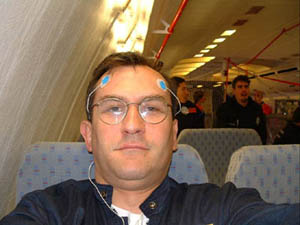
skin conductance recording
Electrophysiological signals
These signals were recorded by means of an ELA Medical device composed of three electrodes which collected the electrical gastrointestinal activity as it has already been explained.
We choose to process the data from the first channel because it represents the vertical derivation which is involved in the parabolic flight. Then, these data were introduced into a MATLAB program : this program aims at filtering the data and transforming them in order to produce a spectrum. From this spectrum, we would like to highlight a possible increase in the frequency of the electrical gastrointestinal activity from three cycles per minute to twelve cycles per minute when the subject of the experiment feels a motion sickness.
In this figure, the axis x represents the frequency in Hertz, the axis y represents the number of the parabolic flight and the axis z represents the range of the recorded electrical gastrointestinal activity in microvolt of the subject .
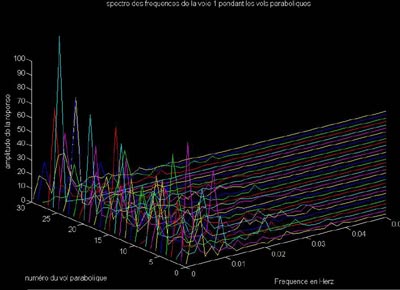
frequencies spectrum during parabolic flight
|
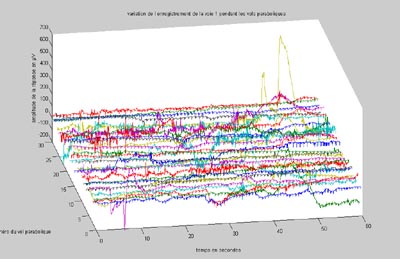
variation of recording during parabolic flight
|
Salivary cortisol
Motion sickness produces a variety of autonomic consequences including salivation, gastric stasis & changed EGG (Harm and al., 1990 ; Golding and al., 1992 ; Golding and al., 1997 ; Gaudeau and al., 1996)).
A variety of 'stress hormones' are released by motion sickness including ACTH, cortisol, as well as the release of other hormones typically observed in stress responses such as growth hormone, thyroid hormone, prolactin, arginine vasopressin, beta endorphin, adrenaline and noradrenaline.
Of these perhaps vasopressin is most closely related to motion sickness but cortisol is most easily measured (Eversmann and al., 1978 ; Kohl, 1990 ; Harm, 1990 ; Reichardt and al., 1998).
A recent study (Golding, 2000) has demonstrated that salivary cortisol, which closely tracks blood cortisol, peaked 20 to 30 min after motion sickness induced by cross-coupled motion. The results of this non-invasive salivary measurement method proved consistent with previous data using invasive blood sampling for cortisol to follow cortisol release in response to motion sickness.
There were large individual differences in cortisol response and these individual differences were related to motion sickness susceptibility where higher motion resistance related to greater cortisol response (Golding, 2000). The latter finding is consistent with the findings of Kohl (Kohl, 1990).
In other types of sickness such as the nausea and vomiting induced by emetogenic cancer chemotherapy with cisplatin, adrenocorticotropic hormone (ACTH) treatment which induces cortisol release, has been shown to be effective in reducing nausea and vomiting (Passalacqua and al., 1997).
There is evidence that corticosteroids may reduce nausea and vomiting due to hyperemesis gravidarum in pregnancy (Taylor, 1996) and reduce postoperative nausea and vomiting (Mataruski and al., 1990).
Lower baseline cortisol has been reported to predict those patients most likely to suffer nausea and vomiting with cisplatin treatment and higher cortisol to predict greater resistance against such nausea and vomiting (Du Bois and al., 1996 ; Fredrikson and al., 1992).
Thus the possibility exists that cortisol although seen as a stress response may be acting also in a protective manner in motion sickness and other types of sickness.
Consequently the results of the proposed study may be useful from two perspectives:
Salivary cortisol release as an non-invasive objective indicator of motion sickness, and
individual differences in salivary cortisol levels as possible predictors of resistance to space motion sickness.
Biofeedback
The autogenic feedback training involves learning self-suggestion exercices to regulate physiological responses to stimuli. Other works have shown that it is possible to control gastric and digestive motricity. Different studies on the ground have been carried out by Martin (Martin and al., 1993) on biofeedback, which is the visualisation of electrophysiological signals, and the learning, using these signals, of the regulation of physiological processes under the control of the central nervous system. This technique will be studied in order to allow astronauts to avoid nausea and vomiting, by means of specialised equipment adapted to nausea resistance training, with the use of a computer.
The originality of the project is the use of expert systems applied to electrosplanchography, which make it possible to test the different relations that can be extracted from tests and can also help to model the efffects of stress and SMS (Gaudeau and al., 1996).
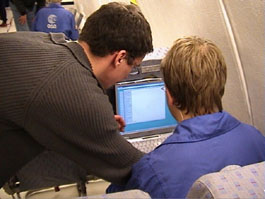
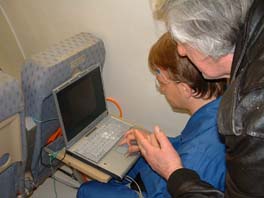
Symptom Checklists computerized recorded on a FUJITSU SIEMENS Lifebook (bio-feedback Man-Machine Interface